

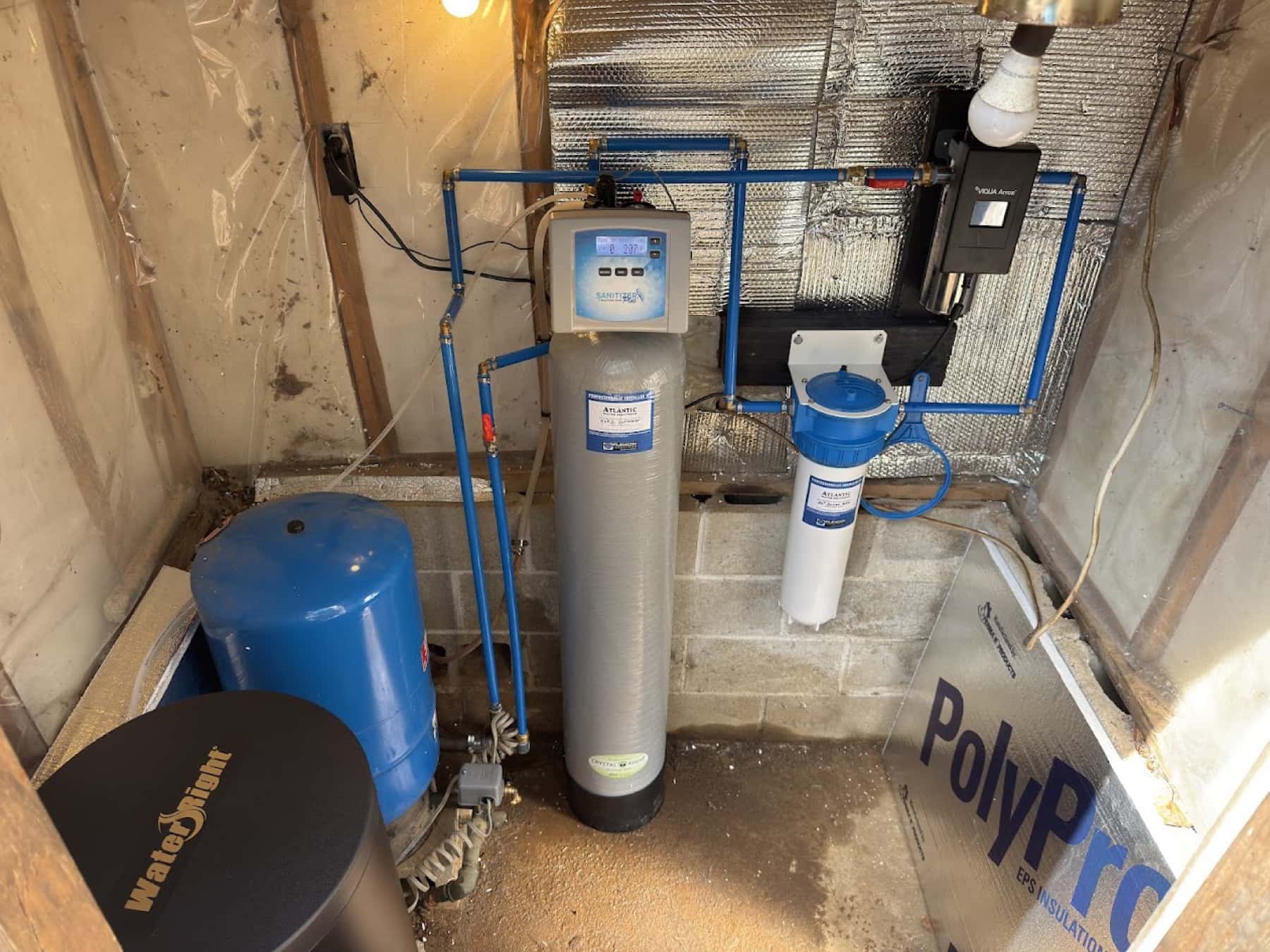
Hard water does its damage quietly. You rarely notice the day a water heater starts to lose capacity or a showerhead clogs a little more. You notice years later, when something fails early. Here is what is going on inside the house, and what a softener actually changes.
What makes water hard
Water picks up calcium and magnesium as it moves through soil and rock. The more of these minerals it carries, the harder it is. Private wells in southern Maine and New Hampshire often run hard, particularly in drilled wells, and you can see it in the lab number, usually reported in grains per gallon or milligrams per liter.
What it does to the house
Heat makes the problem worse. When hard water is warmed, the minerals come out of solution as scale and cling to whatever is nearby. Over time that scale builds on heating elements, in the bottom of tanks and inside pipes, and it insulates the heat from the water, so the heater works harder to do the same job.
The same crust shows up as white film on faucets, spots on glassware, and clogged aerators. Dishwashers and washing machines carry it into valves and pumps. Soap also reacts with hardness, so you use more of it and still feel a film left on skin and in laundry.
- Water heaters: scale reduces efficiency and shortens life
- Fixtures: crust and clogged spray holes
- Appliances: valves and heating elements foul
- Laundry and skin: soap residue and stiffness
What a softener changes
A softener holds a bed of resin beads charged with sodium or potassium. As hard water passes through, the calcium and magnesium stick to the resin and the charge goes into the water in exchange. When the resin is full, the system flushes it with brine, rinses it and goes back to work. The result is water with the hardness taken out, so scale stops forming.
A softener does not purify water. It does not remove bacteria, arsenic or PFAS, and heavy iron can foul the resin unless it is filtered out first. That is why we test before we size one.
Keeping it working
A softener needs salt in the brine tank and an occasional clean-out. A yearly service visit checks settings and resin, and if you would rather not lift bags of salt, we deliver and fill the tank.